




02.12.2025
Geotextiles as the ideal solution for temporary construction roads
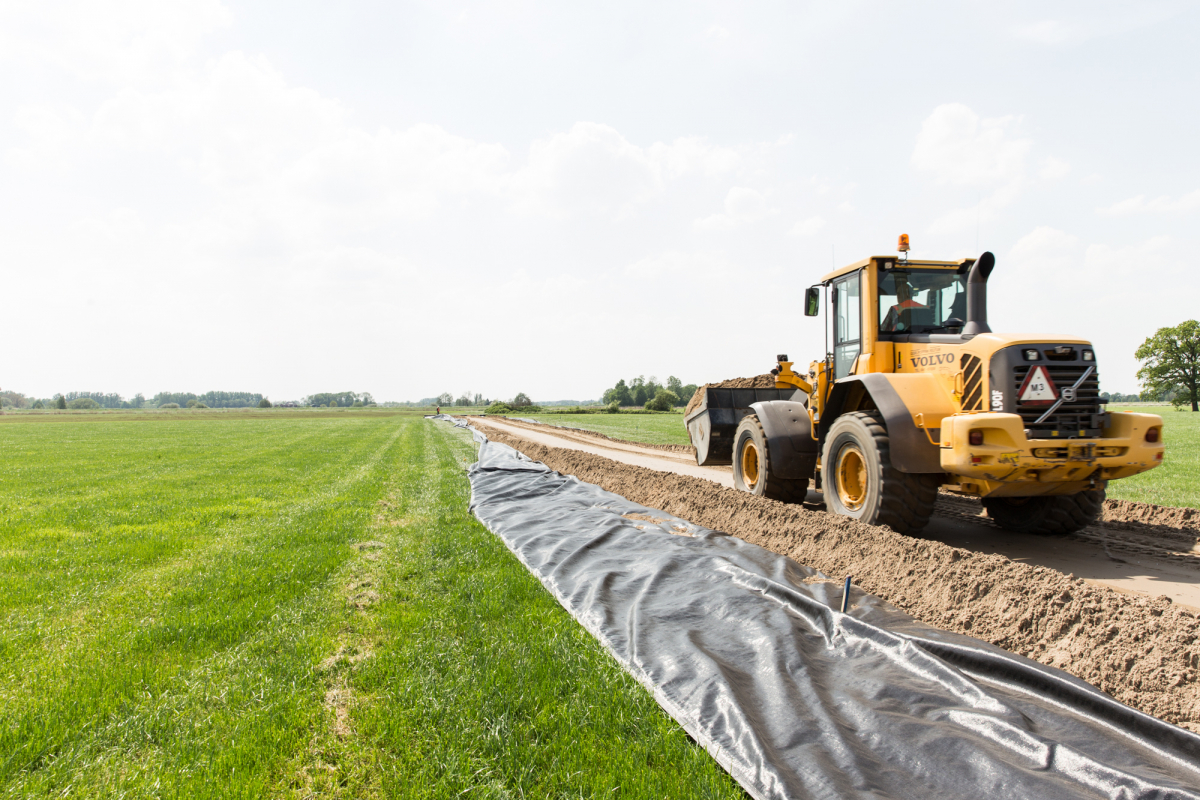
Geotextiles form the basis for temporary construction site roads that provide access to hard-to-reach locations such as farm lands and forest areas.
The global energy transition poses major infrastructural challenges. The construction of new wind turbines, the reinforcement of the electricity grid (underground or above ground)... Numerous major energy projects are in the pipeline in Belgium and neighboring countries. For many of these projects, geotextiles form the basis for temporary construction site roads that provide access to hard-to-reach locations such as farm lands and forest areas. “It prevents gravel from mixing with the subsoil and provides the necessary stability. This makes it possible to transport heavy materials and equipment without any problems,” says Francis Denoo, sales manager at BTT.
BTT, recently acquired by RCP Invest, has long been a renowned global reference in the field of geotextile solutions. It is no surprise that geotextiles are also becoming increasingly established in the infrastructure sector.
Its advantages in terms of sustainability, both in terms of the environment and lifespan, are undeniable. The carbon footprint of BTT's woven geotextiles is among the lowest in the sector. This makes it one of the most sustainable solutions for civil engineering projects, especially when compared to conventional raw materials.
The use of polypropylene, a lightweight and recyclable material, contributes significantly to reducing the environmental impact.
In addition, production is optimized by avoiding fossil fuels, using electricity that is largely generated by solar panels.
RECYCLING AND REUSE
BTT's own recycling line, or that of committed partners in the ecosystem, ensures that all waste is reused. “Re-use” is of vital importance applications such as temporary construction site roads. Although the material is generally designed for a lifespan of 100 years, in these applications it is often only used for a year. This requires specific solutions for disposal and reuse.
Francis Denoo: "When the geotextile is removed, contamination such as clay and soil residues often remain on the fabric. This makes direct reuse for the same application complicated. That is why we focus primarily on recycling."
At present, mechanical recycling is mainly used. This involves washing, shredding, and re-granulating the geotextile.
"Ideally, we would process the granulate into new geotextile, but regulations do not yet allow this, or at least not sufficiently. As an alternative, the granulates can be used for other applications, such as PP channel plates for concrete formwork or agrotextiles," says Francis Denoo. "But we are intensively looking for ways to reuse the granules as much as possible for the same application.
For example, we have already processed 50 m² of geotextile on a laboratory scale and woven it back into a usable fabric.”
INDUSTRIAL SCALE
Upgrading these circular processes to industrial scale is the challenge BTT is now facing. Francis Denoo: "Today, we are looking at the possibilities of recycling approximately 600,000 m²of Terralys LF60/60 that will be released this year on a construction site for reuse. We are setting up an ecosystem with all the partners involved.
We ourselves, the distributors, contractors, (sub)contractors, and recycling companies all need to be on the same page in order to recycle as efficiently as possible. The aim is for the fabric to leave the site as clean as possible.
However, there are still many uncertainties today: what are the regulations governing the transport of the fabrics? What actually falls under the heading of waste? At what point and after what treatments can we no longer refer to it as waste? For example, you cannot simply load used geotextiles into a truck and cross the Belgian border without a certificate.
This issue is now being fully mapped out and addressed.
The first industrial results in the field of processing and recycling are expected early 2026.
Francis Denoo: "Another important point is, of course, the economic model behind it. Recycling is currently a very difficult sector to work in because the price of recycled material is quite high. We must also be vigilant about this as the willingness to pay is often relatively low. A change in mindset is in order."
OUTLOOK
Given the growing demand for sustainable infrastructure in Belgium, the Netherlands, and Germany, geotextiles will remain an indispensable tool for the years to come. "There are major projects on the table, such as the construction of 1,100 kilometers of high-voltage power lines in the Netherlands. Geotextiles will undoubtedly play an important role in this project. Although challenges remain in terms of recycling and regulations, the positive trend towards circular infrastructure projects is irreversible," concludes Francis Denoo.